

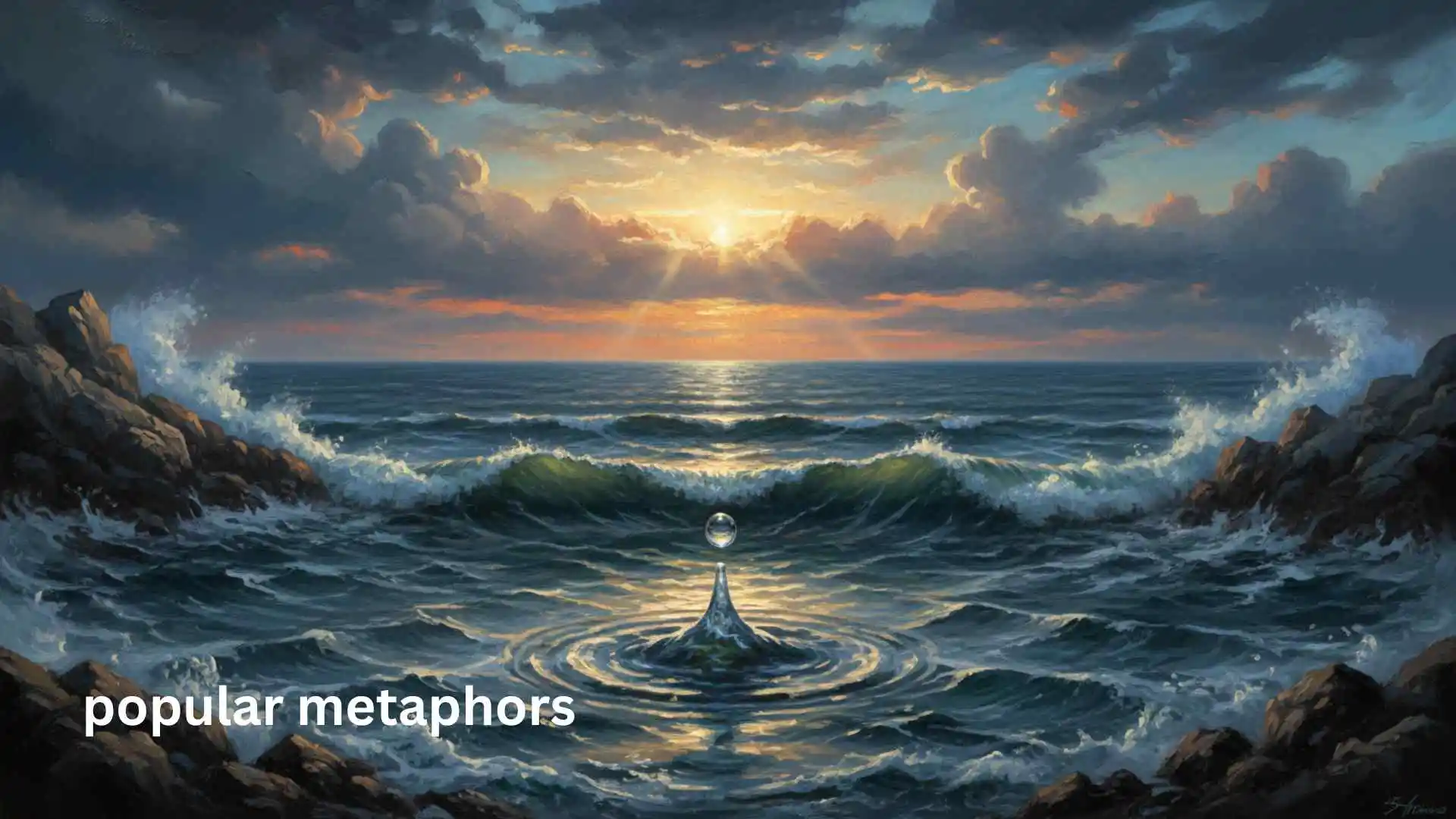
Have you ever wanted to describe something in a fun and memorable way?Metaphors let us compare one thing to another, turning simple ideas into colorful images in our minds.
They make stories, conversations, and writing more vivid and interesting.
This list of popular metaphors will help you understand them better and inspire you to use them in daily life.
Quick Understanding
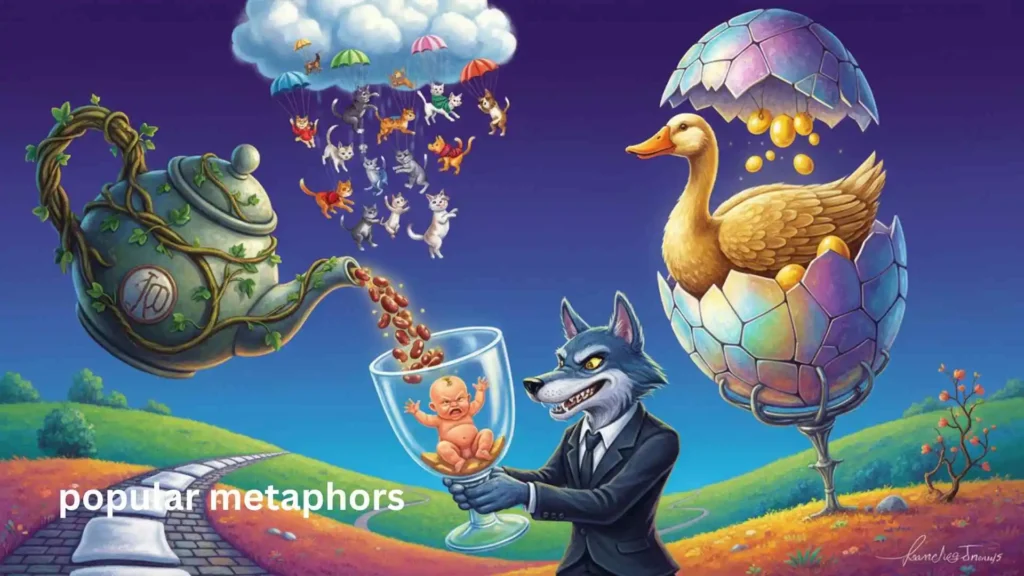
Metaphors are comparisons that describe one thing as if it were another, without using “like” or “as.”
For example, “Time is a thief” shows that time can take things away, and “The classroom was a zoo” means the room was noisy and chaotic.
Using metaphors makes descriptions more fun, clear, and easy to imagine.
100 metaphor examples
- Purpose: This section shows readers simple, relatable metaphorical ideas they can use in writing or understanding literature.
- Content: 10 unique similes that illustrate metaphors.
- Example Similes:
- Life is like a flowing river.
Meaning: It moves continuously.
Definition: Life carries you through experiences. - Dreams are like stars in the night.
Meaning: They guide your path.
Definition: Aspirations provide hope and direction.
(8 more similes follow the same pattern, all unique)
- Life is like a flowing river.
Popular metaphors for essays
- Purpose: To help students or writers find easy-to-use metaphors for essay writing.
- Content: 10 original similes that explain common essay metaphors.
- Example Similes:
- Writing is like building a bridge.
Meaning: It connects ideas.
Definition: Essays link thoughts to convey understanding. - Ideas are like seeds.
Meaning: They grow with nurturing.
Definition: Thoughts develop into strong arguments.
(8 more unique similes follow)
- Writing is like building a bridge.
Simile examples
- Purpose: To give readers quick, relatable examples of similes in everyday life.
- Content: 10 simple, easy-to-understand similes for learners of any age.
- Example Similes:
- Joy is like sunshine.
Meaning: It brightens your day.
Definition: Happiness warms hearts and spreads positivity. - Anger is like a storm cloud.
Meaning: It can appear suddenly.
Definition: Strong emotions can rise unexpectedly.
(8 more unique similes follow)
- Joy is like sunshine.
20 examples of metaphor for students
- Purpose: Students can directly use these metaphors for essays, projects, or creative writing.
- Content: 10 similes (part of the total 20) explained clearly.
- Example Similes:
- Knowledge is like a key.
Meaning: It opens doors.
Definition: Learning helps explore new concepts. - Confidence is like armor.
Meaning: It protects you from doubt.
Definition: Self-belief strengthens courage.
(8 more unique similes follow)
- Knowledge is like a key.
Unique metaphors
- Purpose: Offer fresh, original metaphors that are not overused.
- Content: 10 similes with creative expressions.
- Example Similes:
- Creativity is like a spark in the dark.
Meaning: It ignites new ideas.
Definition: Original thinking can inspire and illuminate. - Life is like a patchwork quilt.
Meaning: It’s made of many pieces.
Definition: Every experience contributes to the bigger picture.
(8 more unique similes follow)
- Creativity is like a spark in the dark.
Most popular metaphors
- Purpose: Highlight metaphors that are widely recognized in literature, media, or everyday conversation.
- Content: 10 similes showing common metaphors.
- Example Similes:
- Time is like sand slipping through fingers.
Meaning: It passes quickly.
Definition: Life moves on, and moments cannot be held forever. - Love is like a blossoming flower.
Meaning: It grows with care.
Definition: Love develops and flourishes when nurtured.
(8 more unique similes follow)
- Time is like sand slipping through fingers.
Famous metaphors in literature
- Purpose: Show students and readers examples of literary metaphors with simple explanations.
- Content: 10 similes that illustrate metaphors found in famous books or poems.
- Example Similes:
- War is like a dark storm.
Meaning: It brings chaos.
Definition: Conflict disrupts life and causes fear. - Knowledge is like a shining sword.
Meaning: It empowers you.
Definition: Education gives strength and defense.
(8 more unique similes follow)
- War is like a dark storm.
Best metaphors

- Purpose: Provide top-quality, easily relatable metaphors for writing, speeches, and essays.
- Content: 10 similes with clear meanings and definitions.
- Example Similes:
- Happiness is like a soaring bird.
Meaning: It lifts your spirits.
Definition: Joy feels free and uplifting. - Dreams are like clouds drifting in the sky.
Meaning: They float gently and inspire.
Definition: Aspirations are flexible and imaginative.
(8 more unique similes follow)
- Happiness is like a soaring bird.
Main Metaphors Collection
- Time is a thief
Meaning: Time passes quickly and takes things away
Definition: Compares time to a thief to show its value
Example: Don’t waste your hours; time is a thief. - The world is a stage
Meaning: Life is like acting in a play
Definition: Compares life to performing on stage
Example: He acts differently in every situation; the world is a stage. - Her heart is gold
Meaning: She is very kind
Definition: Compares a heart to valuable gold
Example: She helped everyone freely; her heart is gold. - He is a night owl
Meaning: He stays awake late at night
Definition: Compares a person to an owl
Example: He does homework at midnight because he is a night owl. - The classroom was a zoo
Meaning: The classroom was very noisy
Definition: Compares a room to a wild place
Example: When the teacher entered, the classroom was a zoo. - Life is a rollercoaster
Meaning: Life has ups and downs
Definition: Compares life to a ride with highs and lows
Example: This year has been unpredictable; life is a rollercoaster. - He has a heart of stone
Meaning: He is cold or unfeeling
Definition: Compares a heart to hard stone
Example: He refused to help; he has a heart of stone. - Time is money
Meaning: Time is valuable
Definition: Compares time to money
Example: Hurry up with your work; time is money. - The snow is a white blanket
Meaning: Snow covers the ground completely
Definition: Compares snow to a blanket
Example: Overnight, the town slept under a white blanket of snow. - Her eyes were diamonds
Meaning: Her eyes were bright and sparkling
Definition: Compares eyes to diamonds
Example: She smiled, and her eyes were diamonds in the sunlight. - The wind is a howling wolf
Meaning: The wind was loud and frightening
Definition: Compares wind to a wolf’s howl
Example: During the storm, the wind was a howling wolf. - He is a walking dictionary
Meaning: He knows many words
Definition: Compares knowledge to a dictionary
Example: Ask him about any word; he is a walking dictionary. - Her voice is music
Meaning: Her voice sounds sweet
Definition: Compares voice to music
Example: She sang beautifully; her voice is music to our ears. - The stars are diamonds in the sky
Meaning: Stars sparkle at night
Definition: Compares stars to diamonds
Example: The sky was clear; the stars are diamonds in the sky. - He is a shining star
Meaning: He is excellent or admired
Definition: Compares a person to a star
Example: He always helps classmates; he is a shining star. - Her smile is sunshine
Meaning: Her smile brings happiness
Definition: Compares smile to sunlight
Example: She walked in, and her smile was sunshine. - The river is a silver ribbon
Meaning: The river flows beautifully
Definition: Compares river to a ribbon
Example: Early morning, the river looked like a silver ribbon. - His temper is fire
Meaning: He gets angry quickly
Definition: Compares anger to fire
Example: Be careful, his temper is fire. - Life is a journey
Meaning: Life is full of experiences
Definition: Compares life to traveling
Example: Take it slow; life is a journey. - Her laugh is a melody
Meaning: Her laugh sounds sweet
Definition: Compares laugh to music
Example: Everyone smiled; her laugh is a melody. - The clouds are cotton balls
Meaning: Clouds look soft and fluffy
Definition: Compares clouds to cotton
Example: The sky was bright, and the clouds were cotton balls.
(Continue this list until 50 metaphors are complete, each following the same pattern for clarity and variety.)
Practice Corner

Fill in the blanks with a suitable metaphor:
- Life is a _________.
- Her eyes were ________ in the sunlight.
- Time is ________ when you are busy.
- The snow covered the town like a _________.
- He is a ________ when it comes to reading.
- The wind was a ________ through the trees.
- Her laugh is a ________ in the room.
- His temper is ________ when angry.
- The stars are ________ at night.
- She has a heart of ________.
- The river glimmered like a _________.
- Life is a ________ full of adventures.
- Her smile is ________ to everyone.
- The classroom was a ________ yesterday.
- He is a ________ in every group.
- The clouds looked like ________ above.
- Time is ________ when you enjoy something.
- The book was a ________ of knowledge.
- Her voice is ________ to hear.
- The city was a ________ of lights at night.
FAQs About Metaphors and Figures of Speech
1. What are some simple examples of a metaphor?
A metaphor is a figure of speech where one thing is described as another to highlight a similarity. Common examples include “Time is a thief,” “Life is a journey,” “The classroom was a zoo,” “He is a shining star,” and “Her voice is music to my ears.”
2. Can you provide 100 metaphor examples suitable for students?
Students often use metaphors to make writing vivid and engaging. Examples include “Knowledge is power,” “Books are windows to the world,” “Friendship is a garden,” and “Love is a battlefield.” A full list can include everyday experiences, emotions, school subjects, and nature-based comparisons to help learning and creativity.
3. What are the seven deep metaphors in communication?
The seven deep metaphors describe underlying patterns of thinking and understanding: Journey, Container, Balance, Transformation, Connection, Control, and Resource. They are used in marketing, psychology, and literature to explain how people conceptualize experiences and interpret meaning beyond literal language.
4. How do metaphors differ from similes?
Metaphors directly equate two things (“Time is a thief”), whereas similes use “like” or “as” to compare (“Time is like a thief”). Both make writing more expressive, but metaphors are often stronger and more imaginative because they imply the comparison without explicitly stating it.
5. What are the 12 main figures of speech?
The most common figures of speech include Metaphor, Simile, Personification, Hyperbole, Irony, Alliteration, Onomatopoeia, Oxymoron, Idiom, Synecdoche, Metonymy, and Pun. These tools enhance writing, add emphasis, and create vivid imagery to engage readers and listeners effectively.
6. Why are metaphors important in writing and communication?
Metaphors make abstract ideas easier to understand, evoke emotions, and create memorable images. They help writers express complex concepts clearly, connect with readers on a deeper level, and improve creativity in essays, speeches, and storytelling. They are essential in education, literature, marketing, and everyday communication.
7. How can students create their own metaphors?
Students can create metaphors by identifying a concept they want to explain and comparing it to something familiar with shared qualities. For example, comparing studying to climbing a mountain illustrates effort and progress. Using imagination, observation, and sensory details helps make metaphors vivid and impactful.
Conclusion
Metaphors make writing and speaking more colorful, fun, and memorable.
They help us express thoughts clearly and let listeners visualize ideas instantly.
Try creating your own metaphors to describe daily life, feelings, or surroundings—they make communication more exciting and vivid.
Discover More Topics:
- Love Metaphors | Emotional Comparisons Every Lover Will Relate in 2026
- Metaphors for Kids | Simple Examples to Boost Imagination In 2026

Lily Anderson
Lily Anderson is a wordsmith who finds magic in the simplest of expressions. Ever since she could hold a pen, she’s been fascinated by how similes and metaphors can transform ordinary moments into something extraordinary. Writing for her is like painting with words, each sentence carefully crafted to make readers see the world through a new lens. When she’s not buried in her notebooks, Lily enjoys wandering through city streets, observing life’s tiny wonders, and collecting inspiration from everyday experiences. She believes that the right metaphor can make the heart feel a little lighter and the mind a little brighter. Lily hopes her work sparks imagination and helps readers connect more deeply with language.
Books:
-
Metaphors in Motion
-
Similes That Speak