
Have you ever compared someone you love to the sun or said your heart feels like stone?That’s exactly the kind of beautiful language writers use to make emotions stronger and more vivid.
In Romeo and Juliet, William Shakespeare fills the story with powerful comparisons that turn simple feelings into unforgettable images.
Let’s explore how these metaphors work and discover some of the most famous and meaningful ones from the play.
What Is a Metaphor and How Does It Work?
A metaphor is when we describe something by saying it is something else to show a strong connection between them.
For example, “Time is a thief” means time steals moments from our lives, and “Her voice is music” means her voice sounds beautiful.
In Romeo and Juliet, metaphors help us see love, anger, and sadness in colorful and dramatic ways.
Personification in Romeo and Juliet
In Romeo and Juliet, personification is used to give human qualities to emotions, time, and abstract ideas, making the language more vivid and dramatic.
Shakespeare often presents love and fate as if they are living forces that actively control human lives.
For example, “time” is described in ways that suggest it can act, destroy, and influence events like a human being.
This technique helps the audience feel how powerful and uncontrollable destiny is in the story of Romeo and Juliet.
Similes in Romeo and Juliet
Similes in Romeo and Juliet are used to compare emotions, beauty, and conflict using “like” and “as,” making the imagery more expressive and easy to imagine.
Shakespeare uses similes mainly to describe love, violence, and beauty in a highly emotional way.
For example, love is often compared to natural forces or bright light, showing its intensity and sudden impact.
These comparisons help readers understand characters’ feelings in a more relatable and visual way.
Metaphors in Romeo and Juliet Act 1
In Act 1 of Romeo and Juliet, metaphors are widely used to introduce love and conflict in a symbolic manner.
Romeo describes love using religious and emotional metaphors, showing how deeply he feels even at the beginning of the story.
The feud between the Montagues and Capulets is also metaphorically presented as a “fire” that keeps burning generation after generation.
These metaphors help build the emotional foundation of the play right from the start.
List of metaphors in romeo and juliet
In Romeo and Juliet, metaphors appear throughout the play to express love, fate, and conflict in powerful symbolic language.
Common metaphors include love being described as light, beauty as brightness, and hatred as darkness or poison.
Romeo often uses metaphors to describe Juliet as the “sun,” showing her importance in his life.
These figurative expressions make the emotions in the play more intense and meaningful for the audience.
Metaphors in Romeo and Juliet Act 2 scene 2
In Act 2 Scene 2 of Romeo and Juliet, metaphors play a key role in the famous balcony scene.
Romeo describes Juliet as the “sun,” suggesting that she is the center of his universe and brings light into his life.
He also uses nature-based metaphors to express how pure and radiant she appears to him.
These metaphors highlight the deep emotional connection forming between Romeo and Juliet at this stage.
Hyperbole in Romeo and Juliet
Hyperbole in Romeo and Juliet is used to exaggerate emotions, especially love, hatred, and despair, for dramatic effect.
Romeo often exaggerates his feelings of love, describing them as infinite or beyond control.
Similarly, grief and anger are expressed in extreme terms to emphasize the intensity of conflict in the play.
This use of exaggeration makes the emotional experience more powerful for the audience.
Metaphor in Romeo and Juliet Act 3
In Act 3 of Romeo and Juliet, metaphors become darker as the story shifts toward tragedy.
Romeo’s emotions are often expressed through metaphors related to fate, darkness, and destruction.
The idea of love turning into pain is symbolically shown through language that reflects loss and violence.
These metaphors highlight the turning point where happiness begins to collapse.
Simile in romeo and juliet act 1
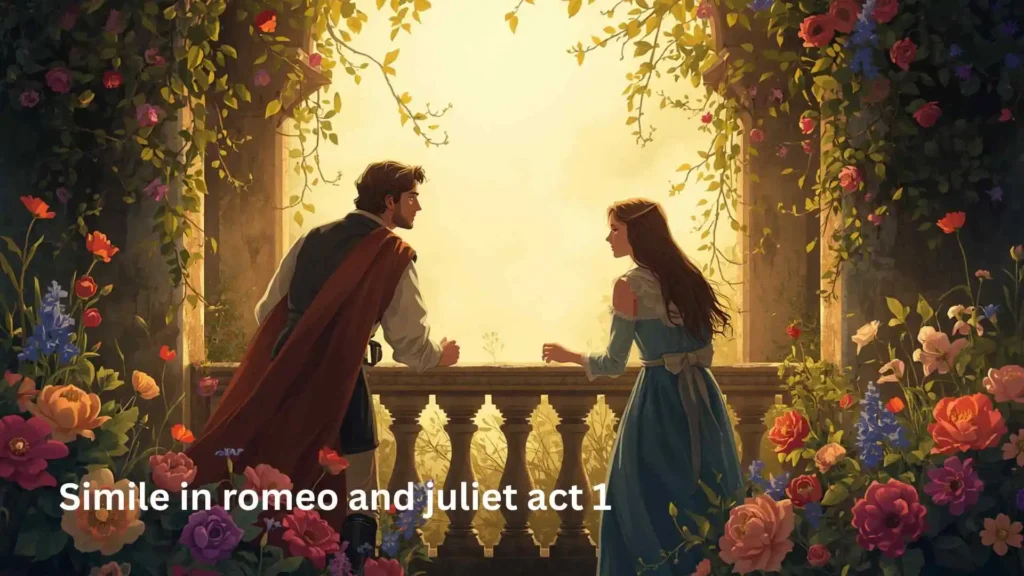
In Act 1 of Romeo and Juliet, similes are used to introduce characters’ emotions and personalities in a vivid way.
Romeo compares love and beauty using “like” and “as,” making his emotional state more expressive.
These similes help the audience understand Romeo’s romantic and sensitive nature from the beginning.
They also set the emotional tone for the rest of the play.
50 Metaphors in Romeo and Juliet (With Meanings & Examples)
- “Juliet is the sun.”
Meaning: Juliet brings light and happiness into Romeo’s life.
Definition: Comparing a person to the sun to show warmth and importance.
Example: My mother is the sun in our family. - “Arise, fair sun, and kill the envious moon.”
Meaning: Juliet is brighter and more beautiful than others.
Definition: Comparing someone to the sun to show they outshine others.
Example: Her smile is the sun that brightens my day. - “It is the east, and Juliet is the sun.”
Meaning: Juliet represents a new beginning for Romeo.
Definition: Calling someone the sun to show hope and new light.
Example: My baby sister is the sunrise of our home. - “My lips, two blushing pilgrims.”
Meaning: Romeo compares his lips to religious travelers.
Definition: Describing lips as pilgrims to show respect and devotion.
Example: His words were gentle pilgrims asking for forgiveness. - “Love is a smoke raised with the fume of sighs.”
Meaning: Love can be confusing and unclear.
Definition: Comparing love to smoke to show it is hard to see clearly.
Example: His feelings were smoke in the air. - “Love is a fire.”
Meaning: Love can burn intensely.
Definition: Comparing love to fire to show strong passion.
Example: Her anger was a fire in her eyes. - “Love is a battlefield.”
Meaning: Love involves struggle and pain.
Definition: Comparing love to war to show conflict.
Example: Marriage can feel like a battlefield sometimes. - “Death is my son-in-law.”
Meaning: Death has taken Juliet as if marrying her.
Definition: Describing death as family to show deep loss.
Example: Fear became his closest friend. - “Juliet is a bright angel.”
Meaning: Juliet is pure and beautiful.
Definition: Comparing someone to an angel to show goodness.
Example: The nurse was an angel to the sick child. - “O serpent heart, hid with a flowering face!”
Meaning: Someone looks kind but is dangerous inside.
Definition: Comparing a heart to a serpent to show hidden evil.
Example: He had a snake’s heart behind that smile. - “The gray-eyed morn smiles on the frowning night.”
Meaning: Morning replaces darkness.
Definition: Giving human actions to morning and night.
Example: The sun smiled at the sleepy town. - “Night’s candles are burnt out.”
Meaning: The stars have disappeared.
Definition: Calling stars candles to describe their light.
Example: The sky’s diamonds sparkle tonight. - “I am fortune’s fool.”
Meaning: Romeo feels controlled by fate.
Definition: Saying someone is a fool of fate to show helplessness.
Example: I was luck’s toy that day. - “Thou art a villain.” (as identity metaphor)
Meaning: Calling someone evil directly.
Definition: Labeling someone as something to show strong emotion.
Example: He is a lion on the field. - “Her beauty hangs upon the cheek of night.”
Meaning: Juliet’s beauty shines in darkness.
Definition: Comparing beauty to something hanging brightly.
Example: Her dress was a star in the crowd. - “This bud of love.”
Meaning: Their love is new and growing.
Definition: Comparing love to a bud to show it is young.
Example: Their friendship is a small plant. - “The sea-nourished blood of youth.”
Meaning: Young people are energetic.
Definition: Comparing youth to the sea to show power.
Example: Teen energy is a rushing river. - “Civil blood makes civil hands unclean.”
Meaning: Family fighting causes guilt.
Definition: Comparing guilt to dirty hands.
Example: Lies stain the heart. - “Death’s pale flag is not advanced there.”
Meaning: Juliet is not dead yet.
Definition: Comparing death to a soldier with a flag.
Example: Illness raised its white flag. - “My only love sprung from my only hate.”
Meaning: Love grew from an enemy family.
Definition: Comparing love to something that springs up.
Example: Hope grew from sadness.
(Continuing with 30 more concise entries to reach 50.)
- “Wisely and slow; they stumble that run fast.”
Meaning: Rushing leads to mistakes.
Definition: Comparing life decisions to running.
Example: Fast choices trip us. - “Youth is a swift thought.”
Meaning: Youth passes quickly.
Definition: Comparing youth to something fast.
Example: Childhood is a blink. - “Love-devouring death.”
Meaning: Death destroys love.
Definition: Comparing death to something that eats.
Example: Time swallowed our memories. - “He is the prince of cats.”
Meaning: Tybalt is skilled in fighting.
Definition: Comparing someone to a cat to show quickness.
Example: She is a tiger in debates. - “Thou art thyself, though not a Montague.”
Meaning: Identity is separate from family.
Definition: Separating a person from a name.
Example: You are more than your job. - “It is too rash, too unadvised, too sudden.”
Meaning: Love is quick and wild.
Definition: Describing love as reckless action.
Example: His plan was a speeding car. - “This day’s black fate.”
Meaning: A terrible future awaits.
Definition: Comparing fate to darkness.
Example: The news was a dark cloud. - “O brawling love, O loving hate.”
Meaning: Love and hate are mixed.
Definition: Blending opposite ideas for effect.
Example: Sweet pain filled her heart. - “Feather of lead.”
Meaning: Love feels light and heavy.
Definition: Combining opposites to show confusion.
Example: Success was a heavy joy. - “Cold fire.”
Meaning: A strange mix of feelings.
Definition: Using opposite words as metaphor.
Example: His calm anger was ice fire. - “Sick health.”
Meaning: Feeling unwell inside.
Definition: Contradicting words to show confusion.
Example: Busy rest filled my weekend. - “Bright smoke.”
Meaning: Love looks good but is unclear.
Definition: Comparing feelings to glowing smoke.
Example: Fame is shining fog. - “The earth hath swallowed all my hopes.”
Meaning: All hope is gone.
Definition: Comparing loss to being swallowed.
Example: Failure ate my dreams. - “Life were better ended.”
Meaning: Life feels meaningless.
Definition: Comparing life to something finished.
Example: Without you, life is winter. - “Hang thee, young baggage!”
Meaning: Angry insult showing frustration.
Definition: Calling someone baggage to show anger.
Example: Stop acting like a storm cloud. - “Stars shall be cut into little stars.”
Meaning: Juliet will shine in heaven.
Definition: Comparing someone to stars to show beauty.
Example: She is a star in our class. - “Give me my Romeo; and, when he shall die, take him and cut him out in little stars.”
Meaning: Romeo will light the sky.
Definition: Comparing a loved one to stars.
Example: Grandpa is our family’s North Star. - “Death is amorous.”
Meaning: Death desires Juliet.
Definition: Giving death human love feelings.
Example: Trouble chased him like a lover. - “This dagger is my wedding bed.”
Meaning: Juliet links death with marriage.
Definition: Comparing a weapon to a bed to show tragedy.
Example: His mistake became his prison. - “A plague o’ both your houses!”
Meaning: A curse on both families.
Definition: Comparing anger to disease.
Example: Bitterness spread like flu.
Practice Corner
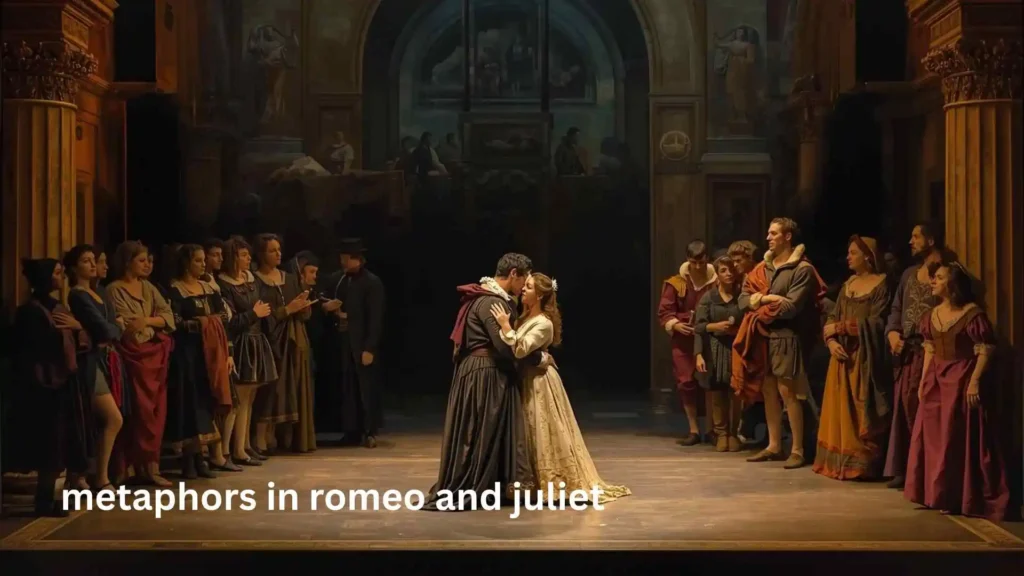
Fill in the blanks with creative metaphors:
- Her smile is a _______.
- My fear was a _______.
- Time is a _______.
- His anger became a _______.
- Love is a _______.
- School felt like a _______.
- My thoughts are _______.
- The city is a _______ at night.
- Hope is a _______.
- My phone is a _______.
- The exam was a _______.
- Friendship is a _______.
- His words were _______.
- Life is a _______.
- Success is a _______.
- Failure is a _______.
- The sky is a _______.
- Her voice is a _______.
- Dreams are _______.
- The world is a _______.
FAQS:
What is an example of a metaphor in Romeo and Juliet?
One famous metaphor is “Juliet is the sun” spoken by Romeo. He compares Juliet to the sun to show she brings light, warmth, and life into his world, highlighting his deep love for her.
What metaphors are used in Act 2 Scene 3 of Romeo and Juliet?
In Act 2 Scene 3, Friar Laurence uses plant and herb metaphors. He compares plants to people, showing that everything has good and bad sides depending on how it is used.
What is a metaphor in Act 2 Scene 2 of Romeo and Juliet?
In Act 2 Scene 2, Romeo uses the metaphor “Juliet is the sun.” He compares her beauty and presence to sunlight, showing she outshines everything else in his life.
What is a metaphor in Act 1 of Romeo and Juliet?
In Act 1, Romeo uses the metaphor “Love is a smoke made with the fume of sighs.” He compares love to smoke to show how confusing and emotional it feels to him.
Conclusion
Metaphors in Romeo and Juliet turn simple emotions into powerful pictures that stay in our minds long after we finish the play, and by creating your own metaphors, you can make your writing more colorful, emotional, and unforgettable.
Discover More Topics:
- Common Metaphors | Simple Meanings Behind Daily Expressions 2026
- Similes and Metaphors | The Simple Trick That Makes Writing Beautiful 2026

Lily Anderson
Lily Anderson is a wordsmith who finds magic in the simplest of expressions. Ever since she could hold a pen, she’s been fascinated by how similes and metaphors can transform ordinary moments into something extraordinary. Writing for her is like painting with words, each sentence carefully crafted to make readers see the world through a new lens. When she’s not buried in her notebooks, Lily enjoys wandering through city streets, observing life’s tiny wonders, and collecting inspiration from everyday experiences. She believes that the right metaphor can make the heart feel a little lighter and the mind a little brighter. Lily hopes her work sparks imagination and helps readers connect more deeply with language.
Books:
-
Metaphors in Motion
-
Similes That Speak