
You might have heard people online say “40 acres and a mule” and wondered what it actually means. It shows up in memes, history videos, and even serious political discussions. But most people don’t really understand where it comes from or why it still matters today.
This phrase is deeply connected to American history after the Civil War, when millions of formerly enslaved people were promised land and basic resources to rebuild their lives. Over time, it became a powerful symbol of broken promises and racial inequality.
Understanding this phrase helps us understand history, justice, and why certain topics still spark emotion today. Based on historical research and modern cultural analysis, this meaning is still widely discussed in education and social debates.
What Does 40 Acres and a Mule Mean
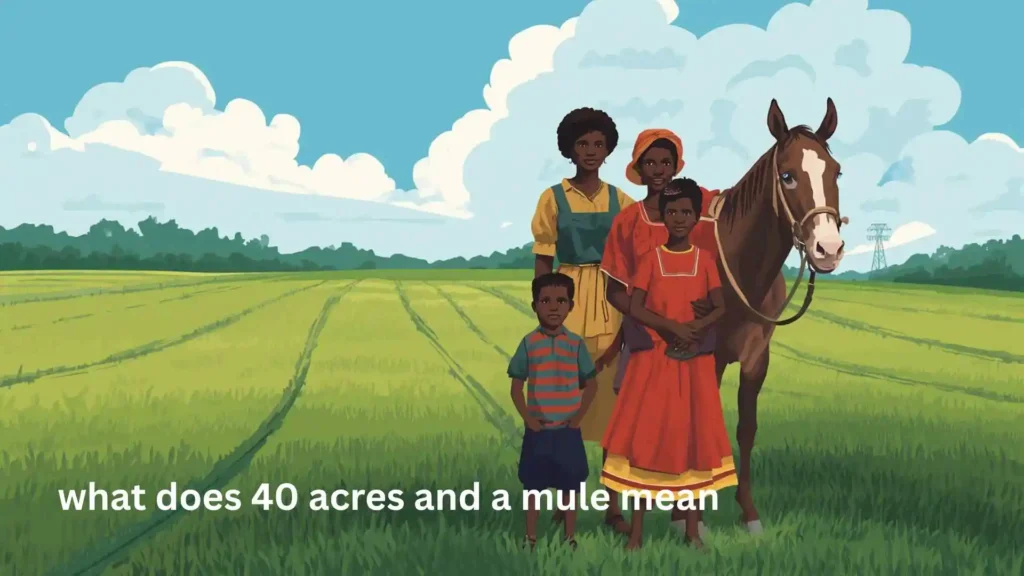
“40 acres and a mule” refers to a promise made during the U.S. Reconstruction period that formerly enslaved African Americans would receive 40 acres of land and sometimes a mule to help them farm and rebuild their lives. However, most of these promises were never fully delivered, making the phrase a symbol of broken justice and unfulfilled freedom.
Meaning & Definition
The phrase “40 acres and a mule” has both a literal and symbolic meaning.
Primary meaning:
It refers to a government plan after the Civil War to give freed enslaved people land (about 40 acres) and farming animals (a mule) for independence.
Secondary meaning:
It symbolizes unfair treatment, broken promises, and the long struggle for equality in America.
Simple examples:
- “He said we were promised 40 acres and a mule, but nothing ever came.”
- “This issue feels like another 40 acres and a mule situation—big promises, no results.”
Background & Origin
The phrase comes from the aftermath of the Civil War during the period known as the Reconstruction era. Reconstruction Era
During this time, many formerly enslaved people expected land redistribution. In 1865, Union General William T. Sherman issued Special Field Order No. 15, which suggested giving land to freed families in parts of the South.
The idea was simple: give land to people who had been enslaved so they could become independent farmers.
However, after President Abraham Lincoln’s assassination and political changes, most of these land promises were reversed. As a result, the majority of freed people never received the land or mules they were promised.
That is why the phrase became a lasting symbol of “promised but not delivered justice.”
Usage in Different Contexts
Casual Chats
People use it when talking about unfair treatment or broken promises.
Example: “Bro, that’s like 40 acres and a mule—nothing ever happens.”
Social Media
Used in memes, captions, and history posts.
Example: “Still waiting on my 40 acres and a mule 😭”
Professional Use
Used in history, sociology, and political discussions.
Example: “The policy reflects a modern version of the 40 acres and a mule debate.”
Gaming / Group Chats
Used jokingly when rewards are delayed.
Example: “We won the match but no loot? 40 acres and a mule vibes.”
Meanings Across Platforms (Table)
| Platform | Tone | Example |
| Casual | “This delay is giving 40 acres and a mule energy 😂” | |
| Meme/viral | “Still waiting on my rewards like 40 acres and a mule” | |
| TikTok | Trendy | “History explained: 40 acres and a mule in 30 sec” |
| Snapchat | Playful | “No bonus? 40 acres and a mule moment” |
| Discord | Gaming slang | “Loot system = 40 acres and a mule situation” |
Real-Life Examples & Memes
Chat-style:
- “They promised us benefits… still nothing. 40 acres and a mule again.”
- “This job interview ghosted me—classic 40 acres and a mule moment.”
Meme-style lines:
- “Expectation: success. Reality: 40 acres and a mule.”
- “Me waiting for justice like it’s shipping from 1865.”
Cultural or Regional Interpretations
United States / UK:
Strong historical meaning linked to slavery, freedom, and civil rights.
Asia (India, Pakistan, Philippines):
Often understood as a symbol of broken promises or delayed justice in general conversations.
Australia:
Less common, but sometimes used in academic or historical discussions.
Other Meanings
| Field | Meaning | Description |
| History | Reparations | Land promise to freed slaves |
| Politics | Policy failure | Example of unfulfilled government promises |
| Sociology | Inequality symbol | Represents systemic injustice |
| Culture | Meme phrase | Used in humor and social commentary |
Common Mistakes & Misconceptions
- Thinking it was fully implemented for all freed slaves
- Believing it was a modern political slogan only
- Assuming it literally means farming advice
- Using it without understanding its serious historical background
- Confusing it with general compensation programs
Psychological / Emotional Meaning
Positive:
Represents hope for fairness and justice.
Neutral:
Used as a historical reference in education.
Negative:
Symbol of betrayal, injustice, and broken promises.
Similar Terms & Alternatives (Table)
| Word/Phrase | Meaning | Tone |
| Reparations | Compensation for injustice | Formal |
| Broken promise | Unfulfilled commitment | Neutral |
| Justice denied | Lack of fairness | Serious |
| Empty promise | Something not delivered | Casual |
Is It Offensive or Friendly?
The phrase itself is not offensive, but it carries serious emotional weight. In historical discussions, it is respectful and educational. However, using it jokingly in sensitive contexts may feel disrespectful to some people because it relates to slavery and inequality.
Grammar or Linguistic Insight
The phrase became popular as a fixed expression, not because of grammar rules but because of history and storytelling. It shows how language can turn real events into symbolic expressions that last for generations.
How to Respond
- “That phrase comes from U.S. history after the Civil War.”
- “It means a promise of land that was never fully given.”
- “It’s often used to talk about broken promises.”
- “It has deep historical meaning related to freedom and justice.”
Differences From Similar Words (Table)
| Phrase | Meaning |
| 40 acres and a mule | Historical land promise after slavery |
| Reparations | General compensation for harm |
| Land grant | Legal land ownership given by government |
| Compensation | Payment for loss or damage |
Relevance in Dating & Online Culture
In modern Gen Z culture, the phrase sometimes appears in dating memes or jokes about “waiting for effort” or “promises not kept.” On apps like Tinder or Instagram DMs, it is often used humorously to describe someone who talks big but doesn’t act.
Example:
“Still waiting on that date plan… 40 acres and a mule energy.”
Popularity & Trends
The phrase frequently appears on TikTok history explainers, Twitter/X debates, and meme culture. Gen Z often uses it ironically to express frustration or exaggerate disappointment in a funny way.
History creators also use it to explain racial inequality in short educational videos.
When NOT to Use 40 Acres and a Mule
Avoid using this phrase in:
- Formal job interviews or professional emails
- Academic writing without explanation
- Serious discussions about race without sensitivity
- Situations where humor may be offensive
- Legal or official documentation
It should be used carefully because it is tied to slavery and historical injustice.
FAQs
1. What does 40 acres and a mule mean simply?
It means a promise of land and resources made to freed slaves after the Civil War that was mostly not fulfilled.
2. Is 40 acres and a mule real history?
Yes, it comes from real Reconstruction-era policies in the United States after slavery ended.
3. Why is it important today?
It represents broken promises and is often discussed in equality and justice debates.
4. Who created the idea?
It was associated with Union policies during the Reconstruction Era, especially General Sherman’s order.
5. Is it used in modern slang?
Yes, it is often used online as a humorous way to describe unmet expectations.
Conclusion
The phrase “40 acres and a mule” is more than just history—it is a powerful reminder of promises made and not kept. It reflects the struggles of freed people trying to build a new life after slavery and still echoes in modern conversations about fairness and justice. Even today, it remains a symbol of hope, disappointment, and the long journey toward equality. Understanding it helps us see how history still shapes the world we live in.
Discover More Topics:
- What Does Six Seven Mean? Hidden Slang Meaning Explained
- What Does RS Mean in Text? The Real Meaning Behind This Viral Chat Slang
- What Does Yellow Discharge Mean | Causes, Symptoms & When to Worry
- What Does “ION” Mean in Text? The Real Gen Z Slang Explained Simply in 2026

Oliver Sinclair
I’ve always been fascinated by the way words can dance and paint pictures in the mind. Similes and metaphors, to me, are more than literary tools—they are bridges between ordinary language and extraordinary imagination. Writing has been my way of exploring emotions, nature, and the hidden connections that often go unnoticed. Every sentence I craft is an experiment, a little spark of creativity meant to make readers see the world differently. When I’m not lost in words, you can find me wandering through forests or sketching ideas in a notebook. Sharing the magic of language has always been my greatest joy, and I hope my work inspires others to play with words too.
Books:
-
Whispers in the Wind
-
Shadows of Thought